
Board guide · Malaysia
Melamine vs Plywood vs Blockboard for Cabinets in Malaysia
Plywood, melamine board, blockboard, chipboard and MDF compared for kitchen cabinets and wardrobes, by a carpentry workshop in Batu Caves that builds in plywood as standard.
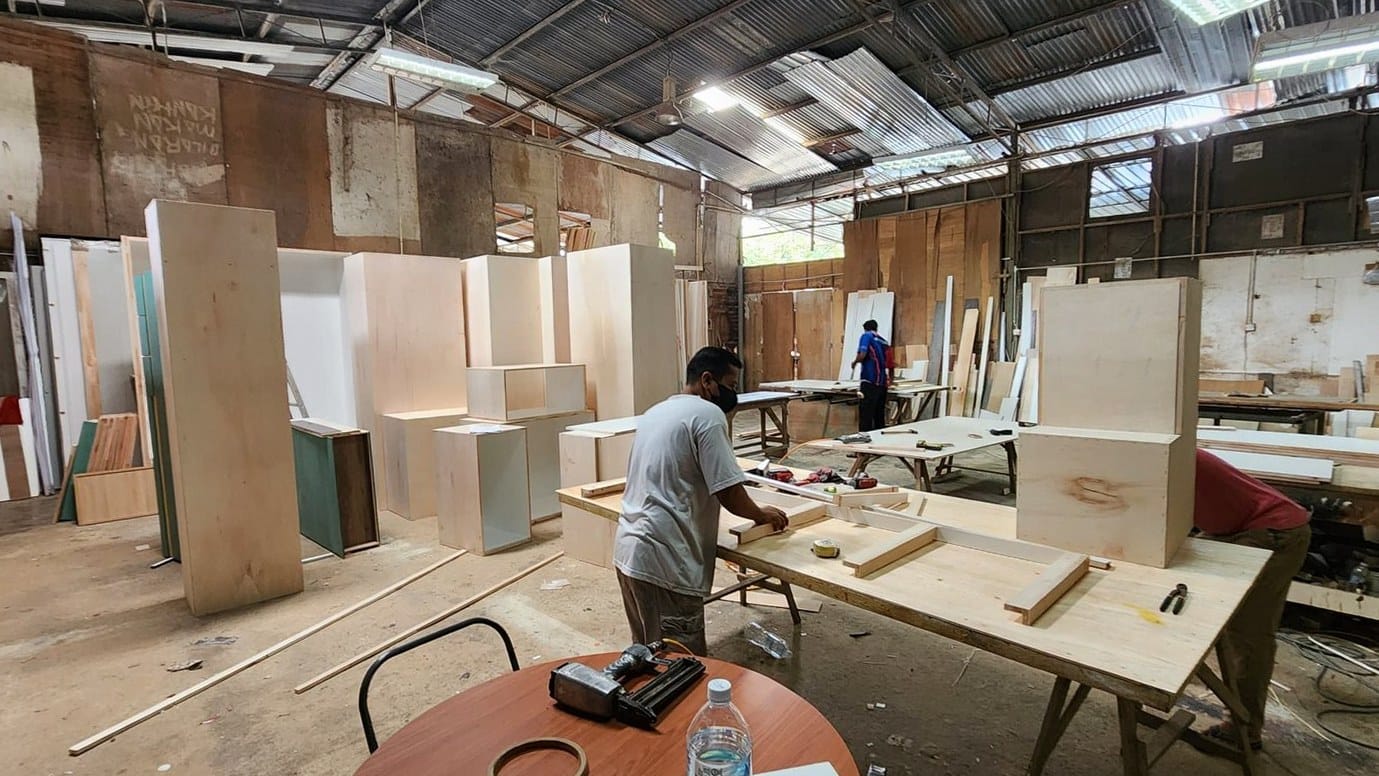
For kitchen cabinets and wardrobes in Malaysia, plywood is the safest carcass. It holds screws when hinges are adjusted years later, copes with the humidity and survives a leak under the sink without swelling. Melamine board, which is chipboard or MDF with a melamine face, costs less and works for cabinets that stay dry. Blockboard is good for long shelves and doors in dry rooms. MDF is the board for painted doors, not for a sink cabinet.
We build every carcass in plywood as standard and finish it in laminate. Chipboard is available if you ask for it, for dry upper cabinets, and melamine or acrylic doors are available on request too. Below is how the boards compare, where each one fails, and what we charge.
First, melamine is a finish, not a board
Most of the confusion starts here. Melamine is a paper soaked in resin and fused onto a board at the factory. The board underneath is usually chipboard, sometimes MDF. So “melamine vs plywood” really means chipboard or MDF with a factory face, against plywood with a face added in the workshop.
Laminate is a different thing again. High-pressure laminate (HPL) is a separate, thicker sheet that the carpenter glues onto whichever board you choose. It stands up to scratches, knocks and heat better than melamine, which is why we put it on plywood for doors and exposed panels. Veneer, a thin slice of real timber, we do not offer, because it does not hold up well in Malaysian humidity.
Here are the five boards you will see in a cabinet quotation:
- Plywood: thin wood veneers glued in layers, with the grain of each layer crossing the one below. The crossing grain is what makes it strong and good at holding screws.
- Chipboard (particle board): wood chips and resin pressed into a sheet. It is cheap but heavy, and the core swells and crumbles once water gets in.
- Melamine board: chipboard or MDF with melamine paper fused onto both faces, sold ready finished in a fixed range of colours.
- Blockboard: a core of softwood strips glued side by side, faced with veneer. Light, and stiff over long spans.
- MDF: wood fibres pressed into a dense, smooth sheet with no grain. It takes paint beautifully, but it is heavy and swells if it gets wet.
Melamine vs plywood for kitchen cabinets
A kitchen is hard on cabinets. There is steam from cooking, water around the sink, and in many landed houses a wet kitchen that gets washed down. This is where the two boards part ways.
Water
The melamine face resists water, but the core does not. Water reaches the chipboard through cut edges, hinge holes and any chip in the edge banding. Once it is in, the board swells, the edge goes soft and the hinge screws lose their grip. Plywood takes the same leak and dries out without falling apart, which matters most in the cabinet under the sink.
Screws and hinges
Kitchen doors get opened thousands of times and hinges get adjusted. Plywood holds a screw well, and a worn hole can be repaired. Chipboard needs the right fixings to hold properly, and a stripped hole in chipboard is much harder to fix, so the hinge usually has to move or the panel gets replaced.
Weight
For the same thickness, chipboard and melamine board are heavier than plywood. On wall cabinets that puts more load on the wall fixings, and on a full-height wardrobe it makes every panel heavier to carry up to a condo unit.
Cost
Melamine board costs less, and that is its real advantage. Where a cabinet stays dry, such as kitchen wall cabinets away from the sink, the saving can make sense. We will build those in chipboard if you ask, but we keep the base cabinets, the sink cabinet and anything in a wet kitchen in plywood.
Blockboard vs plywood
Blockboard (also written block board) has a core of softwood strips glued edge to edge, with veneer on both faces. Because the strips run one way, the board is stiff along its length and light for its thickness. That makes it a good choice for long shelves, tables, partitions and doors that have no support in the middle.
Its weak points are moisture and edges. Blockboard is an interior board. Its strip core takes in damp and can open up small gaps, so it does not belong under a sink or in a wet kitchen. The cut edges show the strips and have to be lipped or banded. For cabinet boxes, especially in a kitchen, plywood is the more forgiving board. Blockboard earns its place on long spans in dry rooms.
Chipboard vs plywood
Chipboard, or particle board, is what most flat-pack furniture is made from. It is cheap and fine for a bookshelf in a dry room. In a Malaysian kitchen it has two problems: the core swells once water gets in, and screws loosen over years of use. When a chipboard kitchen fails, it is usually at the bottom edge of the sink cabinet and at the hinges.
If you want chipboard for part of the job, we can use it for dry upper cabinets or a wardrobe in a dry room. We will not put it under a sink or in a wet kitchen, and we will tell you plainly if we think it will not last where you want it.
MDF vs plywood
MDF has no grain and a perfectly smooth surface, so it is the usual board for spray-painted doors and for shaped or routed door designs. It is also heavy, it swells badly when wet, and screws driven into its edge hold poorly. For a cabinet carcass, plywood is the better board. For a painted door that stays dry, MDF is often the right one.
The boards side by side
| Board | Damp and leaks | Holds screws | Weight | Good for | Avoid for |
|---|---|---|---|---|---|
| Plywood | Copes well and dries out | Well | Lighter | Kitchen and sink cabinets, wardrobes, anything built to last | Very little in a home |
| Melamine board | Face resists water, core swells once wet | Weaker, needs the right fixings | Heavy | Dry upper cabinets, shelving in dry rooms | Sink cabinets, wet kitchens |
| Chipboard | Swells once wet | Weaker, needs the right fixings | Heavy | Dry cabinets, flat-pack furniture | Base and sink cabinets, damp rooms |
| Blockboard | Interior only, takes in damp | Good on the faces | Light | Long shelves, tables, doors, partitions | Wet kitchens, bathrooms |
| MDF | Swells badly when wet | Poor at the edges | Heavy | Spray-painted and shaped doors | Carcasses in wet areas |
Which board for which part of the house
- Kitchen base cabinets and the sink cabinet: plywood. This is where leaks happen.
- Wet kitchen: plywood for every cabinet.
- Kitchen wall cabinets away from the sink: plywood as standard, chipboard if you ask for it.
- Wardrobes: plywood. A full-height wardrobe carries a lot of weight on its hinges and rails. Chipboard is possible in a dry room, but we do not recommend it for a full-height unit.
- TV and display cabinets: plywood for the carcass. Long open shelves need a stiff board, either thicker plywood or blockboard, so they do not sag.
- Painted doors: MDF is the usual door board, fitted to a plywood carcass.
Laminate, melamine or acrylic on top
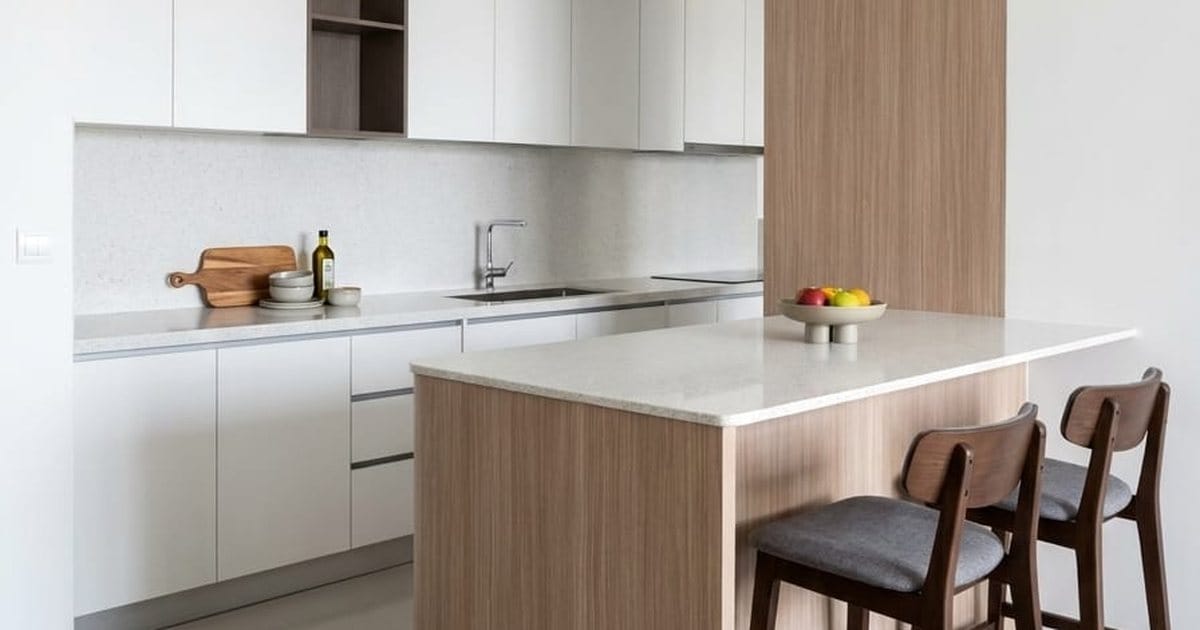
The finish is a separate choice from the board. Our standard is laminate on plywood. It wipes clean, takes knocks and comes in plain colours, woodgrain, stone patterns and matte finishes. Melamine doors and 4G or acrylic high-gloss doors are available on request. Acrylic gives a deep gloss, but it marks more easily than laminate, so it suits a feature door better than the busiest part of a kitchen.
Ask about formaldehyde
All of these boards are made with resin glue, and the glue gives off formaldehyde, most of it in the first months. Boards sold for furniture carry an emission grade. E1 is the common benchmark: under the European chamber test (EN 717-1) the board must stay at or below 0.1 ppm. You will also see “E0” on boards sold in Asia. It is a lower-emission label used by suppliers rather than one official standard, so if it matters to you, for example in a baby’s room, ask for the supplier’s test sheet.
What a plywood cabinet costs with us
These are our rates for plywood carcasses with a laminate finish, delivered and installed:
| Item | Price |
|---|---|
| Kitchen base cabinet, including a basic laminate countertop | RM450 per foot |
| Kitchen wall cabinet | RM225 per foot |
| Base and wall cabinets together | RM675 per foot |
| Quartz countertop instead of laminate | add RM250 per foot |
| Built-in wardrobe | RM620 per foot of width at 5 ft high, up to RM950 at 9 ft, floor to ceiling |
| TV console | RM250 per foot |
So a 10-foot kitchen with base and wall cabinets comes to about RM6,750 in plywood with a laminate top, or RM9,250 with quartz. Chipboard, melamine doors and acrylic doors are priced on request, because the difference depends on how much of the job uses them. For the full breakdown, see our kitchen cabinet price guide and wardrobe cost guide.
How to check which board a quotation uses
A quotation should name the board for the carcass, the doors and the back panel, not just say “cabinet”. Look for:
- the carcass board: plywood, chipboard, blockboard or MDF
- the door board and its finish: laminate, melamine or acrylic
- the back panel and the shelves, which are sometimes a cheaper board than the rest
- edge banding on every cut edge
- the hinges and drawer runners, and whether soft-close is included
If two quotations for the same kitchen are far apart, the board is the first thing to compare.
Questions we get asked
Is plywood better than melamine for kitchen cabinets?
For base cabinets and anything near the sink, yes. Plywood copes with leaks and holds hinge screws better. Melamine board costs less and works for dry upper cabinets.
Is melamine waterproof?
The face resists water, but the core does not. Melamine board is chipboard or MDF underneath, and it swells once water gets in through an edge or a screw hole.
Is blockboard better than plywood?
For long shelves and doors in a dry room it can be, because it is light and stiff. For cabinet boxes, and anything in a kitchen, plywood is the safer board.
Can I use chipboard to save cost?
Yes, on request, for dry upper cabinets or a wardrobe in a dry room. We keep base cabinets, the sink cabinet and wet kitchens in plywood.
Is MDF good for kitchen cabinets?
For painted doors, yes. For the cabinet boxes, especially under the sink, no, because MDF swells badly when it gets wet.
Which board lasts longest in Malaysian humidity?
Plywood. It is the only board on this list we would put in every part of a kitchen.
What board does The M Renovation use?
Plywood for every carcass, finished in laminate, as standard. Chipboard, melamine doors and acrylic doors are available on request.
Planning cabinets or a wardrobe? Send us your floor plan or rough sizes, and tell us which board you have in mind.
Related: kitchen cabinets KL · wet and dry kitchen design · custom wardrobes · TV cabinet & feature wall · display cabinet · kitchen cabinet price guide · wardrobe cost guide · kabinet dapur (Bahasa Malaysia)